Shapes graphs and data graphs
There are two questions that sound like one, and conflating them is the most common way to get a validation run that passes for the wrong reason:
Where do shape definitions come from?
Which triples are visible during evaluation?
They are controlled by different things and have different answers.
Where shapes come from
The rule is the same in every frontend.
One graph in → it is both shapes and data. Supply a single graph and Shifty
reads shape definitions and the data to validate from it. This is the common
combined-file case, where sh:NodeShape definitions sit alongside instance
data.
Two graphs in → shapes come only from the shapes graph. Supply a separate
shapes graph and data graph and the schema is compiled only from the shapes
graph. SHACL vocabulary that happens to live in the data graph is ignored —
a stray sh:property or sh:NodeShape triple in your data will never
quietly become a constraint.
Invocation |
Shapes read from |
Data read from |
|---|---|---|
|
the one graph |
the one graph |
|
|
|
|
the one graph |
the one graph |
|
|
|
Why the asymmetry
It would be more convenient, in the moment, to read shapes from wherever they are found. It is a bad idea for the same reason that letting a payload rewrite its own validation rules is a bad idea: the data is usually the untrusted side.
Data graphs are generated, merged from several sources, and edited by people
who are not thinking about your shapes. If shapes could be sourced from data,
then anyone who can write data can weaken the schema, and — worse — can do it
by accident. Someone copies an example file that happens to include a
sh:NodeShape, or an upstream export includes its own SHACL profile, and now
your validation is checking something other than what you wrote. Nothing fails.
The run stays green.
Keeping the schema fixed makes validation predictable and matches the SHACL specification’s own separation of the two graphs.
Shapes embedded in data
Say so explicitly. Both --shapes and the Python shapes argument accept
multiple sources and union them, so add the data file as an additional shapes
source:
shifty validate --shapes shapes.ttl --shapes data.ttl --data data.ttl
conforms, report, text = shifty.validate(data, [shapes, data])
To validate a combined graph in Python, omit the second argument or pass
None. An explicitly supplied shapes graph that contains no triples raises
ValueError, preventing an accidental vacuous validation from being reported
as successful.
shifty.validate(combined)              # combined is both
shifty.validate(combined, None)        # same
shifty.validate(combined, rdflib.Graph())   # ValueError: empty shapes graph
This guard applies only when the supplied shapes graph has zero triples. A nonempty schema whose targets select no focus nodes remains a valid conforming run.
Which triples are visible
The second question is entirely separate, and applies after the schema is
fixed. It is controlled by graph_mode (--graph-mode on the CLI), and it
governs both where focus nodes are selected and what path traversal,
class-hierarchy lookup, and SPARQL can see.
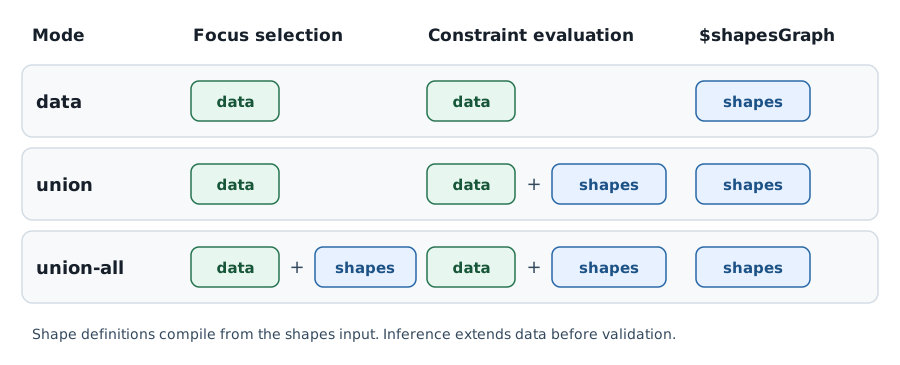
Graph visibility with separate shapes and data inputs. Inference extends the
data side before validation; $shapesGraph keeps naming the shapes source.
Mode |
Focus selection |
Evaluation graph |
|---|---|---|
|
Data |
Data |
|
Data |
Data ∪ shapes |
|
Data ∪ shapes |
Data ∪ shapes |
The default is union because of class hierarchies. sh:class ex:Sensor
has to hold for an ex:TemperatureSensor when the ontology says
ex:TemperatureSensor rdfs:subClassOf ex:Sensor — and that axiom is almost
always authored with the shapes, not with the instance data. Under data
mode the validator cannot see it, and every subclass instance fails a
constraint it satisfies.
So the modes trade off like this. data is the strict reading: the data
graph must stand entirely on its own, ontology included. Use it when you want
to know whether a graph is self-contained. union is the practical default:
the data is validated, the shapes side supplies vocabulary. union-all also
selects focus nodes from the shapes graph, which is useful when the shapes file
contains instances you intend to validate too. It can also select ontology
resources in the shapes graph as validation targets.
infer() takes no graph_mode. Graph modes describe what validation can
see; inference derives additions to the data graph. With separate inputs, rules
can read the data and shapes graphs while selecting their focus nodes from data.
With combined input, rules read the evolving data graph.
SPARQL $shapesGraph always names the original shapes source. It does not
grow when inference adds data triples, even when one input file supplies both
shapes and data. To change the named shapes graph, compile a new shapes source.
Note that expanding the evaluation graph can flip a result in either direction.
It usually makes a constraint easier to satisfy — more triples to traverse —
but it also gives sh:closed more predicates to object to, and gives
sh:maxCount more values to count. Widening the graph is not monotonically
more permissive.