Explain a validation result
A validation result lists failures, but does not identify passing nodes or retain the derivation behind a failure. The evidence interface provides both.
Set up
Use the failing version of data.ttl from the first tutorial, so there is
something to explain:
@prefix ex: <http://example.org/> .

ex:alice a ex:Person ; ex:name "Alice" ; ex:email "alice@example.org" .
ex:bob   a ex:Person ; ex:name 123 .
shapes.ttl is unchanged.
Inspect the validation evidence
An ordinary validation report is lossy on purpose: it tells you what to fix and discards everything else. The evidence interface keeps the derivation instead. Open a session over the two graphs and validate:
import pathlib
import shifty

shapes = pathlib.Path("shapes.ttl").read_text()
data = pathlib.Path("data.ttl").read_text()

session = shifty.EvidenceSession(shapes, data, infer=False)
run = session.validate()

print("conforms:", run.conforms)
for statement in run.statements:
    print(statement.selector, "selected", len(statement.selected_foci))
    for focus in statement.selected_foci:
        print("  ", focus.status, focus.focus)
conforms: False
class(ex:Person) selected 2
   pass <http://example.org/alice>
   fail <http://example.org/bob>
The evidence includes Alice even though the validation report did not. A
statement whose target selected nothing has an empty selected_foci list. A
selected node has status == "pass" or status == "fail" according to its
validation result.
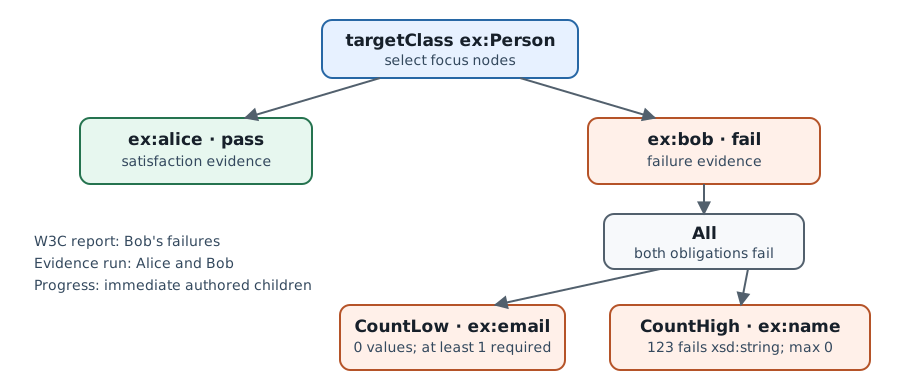
The report lists Bob’s failures. Evidence also records Alice’s pass and the nested reasons for Bob’s failure.
Now ask why Bob failed:
for statement in run.statements:
    for focus in statement.selected_foci:
        if focus.status == "fail":
            print(focus.evidence.explain())
All — fix every:
  All — fix every:
    CountHigh along ex:name: 1 match(es), max 0
      value "123"^^<http://www.w3.org/2001/XMLSchema#integer>:
        Atom at "123"^^<http://www.w3.org/2001/XMLSchema#integer> via ex:name [cuttable]
  CountLow along ex:email: have 0, need 1
This is a tree, not a list, and its shape is the shape of the constraint. The
outer All is the conjunction of Bob’s two property obligations: both
branches failed, and both must be fixed. The CountLow branch is the missing
email, stated as an arithmetic gap — zero values found, one required — rather
than as a message.
The CountHigh branch appears even though shapes.ttl does not declare a
maximum. sh:datatype constrains every value of ex:name, and “every
value satisfies φ” is compiled as “at most zero values satisfy ¬φ”. A
universal constraint therefore appears as a count with max 0; its “match”
is the value that violates the datatype constraint. The
architecture explanation describes this
encoding.
[cuttable] is the engine noting that this leaf rests on a concrete triple —
one that could be pointed at, or removed, to change the outcome. Leaves that
have no such finite support say so instead; Recursion and stratification
covers the case where that happens.
explain() produces text for humans. Programs should use walk(),
constraint_kind, and the structured projections described in
Evidence reference. Evidence is canonical: a failed conjunction keeps
the children that establish the failure and drops passing siblings.
focus.progress contains the immediate authored siblings and their statuses.
Inspect a passing node
Alice conforms. The interesting question is with what — and this is the one a validation report cannot answer at all, because Alice does not appear in it.
Rather than walking the satisfaction tree by hand, use the projections. They work identically on both polarities:
for statement in run.statements:
    for focus in statement.selected_foci:
        evidence = focus.evidence
        print(focus.status, focus.focus)
        print("   matched: ", evidence.matched_values())
        print("   support: ", evidence.supporting_triples())
pass <http://example.org/alice>
   matched:  ['"Alice"', '"alice@example.org"']
   support:  ['<http://example.org/alice> <http://example.org/name> "Alice"',
              '<http://example.org/alice> <http://example.org/email> "alice@example.org"']
fail <http://example.org/bob>
   matched:  ['"123"^^<http://www.w3.org/2001/XMLSchema#integer>']
   support:  ['<http://example.org/bob> <http://example.org/name> "123"^^<http://www.w3.org/2001/XMLSchema#integer>']
matched_values() on Alice returns the two values that actually satisfied her
obligations. That is the answer you would otherwise get by writing a second
query that re-implements the shape’s property paths — and which could drift out
of sync with the shape. supporting_triples() gives the triples underneath
them, in N-Triples form.
Note that Bob has matched values too. On a failing node they mean “these are the
values the constraint counted”, which for his max 0 datatype check is
precisely the value that offended. Which brings us to the failure-side
projections:
for statement in run.statements:
    for focus in statement.selected_foci:
        if focus.status != "fail":
            continue
        print("offending:", focus.evidence.offending_values())
        for gap in focus.evidence.missing_obligations():
            print(f"need {gap.missing} more: "
                  f"observed {gap.observed_count}, required {gap.required_count}")
offending: ['"123"^^<http://www.w3.org/2001/XMLSchema#integer>']
need 1 more: observed 0, required 1
These are structured, not prose: gap.missing is an integer you can act on.
A repair tool, a data-entry form, or a coverage dashboard all want this rather
than the sentence “at least 1 value(s) required”.
See the siblings a proof leaves out
Canonical evidence is decisive: Bob’s tree contains what makes him fail and nothing else. Sometimes you want the fuller picture — “two of these three obligations are met” is useful to a person, and is not what a proof contains.
focus.progress reports the immediate authored children and their statuses:
for statement in run.statements:
    for focus in statement.selected_foci:
        if focus.progress is None:
            continue
        print(focus.focus)
        for child in focus.progress.evaluated_children:
            print("   ", child.source_constraint_ref,
                  child.constraint_kind, child.status)
<http://example.org/alice>
    1 ConstraintKind.Conjunction pass
    8 ConstraintKind.Cardinality pass
<http://example.org/bob>
    1 ConstraintKind.Conjunction fail
    8 ConstraintKind.Cardinality fail
Progress reports that each child passed or failed without materializing why — that is what makes it cheap. When you need the full evidence for one of them, ask the session directly:
detail = session.evidence_for(focus.focus, child.normalized_constraint_ref)
print(detail.status, detail.evidence_kind)
Canonical evidence explains why a result holds. Progress reports the status of
the immediate authored children. evidence_for materializes the derivation
for one child on demand.
Evidence guarantees and cost
The evidence interface retains the validator’s derivation. It uses the same
SHACL evaluation as validate(), with a richer return value from the same
fold.
It also has a cost. Materializing evidence for every selected pair runs 2.5–5.4x the time of deciding conformance, and grows with model size. If you only care about failures — which is most callers — there is a much cheaper path; Evidence performance has the measurements and the entry points.